|
|
|
|
|
|
Establishment
Mesa Verde National Park preserves a spectacular reminder of the 1,000 year culture of the Ancestral Puebloans. Archeologists have called this people Anasazi, from the Navaho word that means "ancient". They are now called Ancestral Puebloans, reflecting their modern descendants
Mesa Verde National Park is located in the Four Corners Area, which has one of the highest concentrations of archeological sites in the United States and borders the Ute Mountain Ute Indian Reservation.
Mesa Verde National Park was established by Congress on 29 June 1906. It was the first cultural park set aside in the National Park System. Mesa Verde National Park was also designated as a World Cultural Heritage Site on September 8, 1978 by UNESCO, an United Nations organization formed to preserve and protect both the cultural and natural heritage of designated international sites. These pre-Columbian cliff dwellings and other works of early people are the most notable and best preserved in the United States.
Designations:
Size and Visitation
Mesa Verde National Park has:
History of the People
Mesa Verde National Park preserves a spectacular reminder of the 1,000 year culture of the Ancestral Puebloans. Archeologists have called this people Anasazi, from the Navaho word that means "ancient". They are now called Ancestral Puebloans, reflecting their modern descendants.
The first Ancestral Puebloans settled in Mesa Verde(Spanish for "green table") about AD 550. They are know as Basketmakers because of their impressive skill at that craft. Formally a nomadic people, they were now beginning to lead a more settled way of life. Farming replaced hunting-and-gathering as their main source of livelihood. They lived in pithouses clustered in small villages, which they usually built on the mesa tops, but occasionally in the cliff recesses. They soon learned how to make pottery and they acquired the bow and arrow, a more efficient weapon for hunting than the atlati (spear thrower).
The pithouse represents the beginning of a settled way of life based on agriculture. Its basic features were a living room, squarish in shape and sunk down a few feet into the ground, four main timbers at the corners to support the roof, a fire pit with an air deflector, an antechamber, which might contain storage bins or pits, and a sipapu. Pithouses evolved into kivas of later times. In Mesa Verde, the people lived in this type of dwelling from about 550 to 750.
These were fairly prosperous times for the Basketmakers, and their population multiplied. About 750 they began building houses above ground, with upright walls made out of poles and mud. They built these houses one against another in long, curving rows, often with a pithouse or two in front. The pithouses were probably the forerunners of the kivas of later time. From then on, these people were known as Pueblos, a Spanish word for village dwellers.
By 1000, the people of Mesa Verde had advanced from pole-and-adobe construction to skillful stone masonry. Their walls of thick, double-coursed stone often rose two or three stories high and were joined together into units of 50 rooms or more. Pottery also changed, as black drawings on a white background replaced simple designs on dull gray. Farming provided more of the diet than before and much mesatop land was cleared for that purpose.
The years from 1100 to 1300 were Mesa Verde's Classic Period. The population may have reached several thousand. It was mostly concentrated in compact villages of many rooms, often with the kivas built inside the enclosing walls rather than out in the open. Round towers began to appear, and there was a rising level of craftsmanship in masonry work, pottery, weaving, jewelry, and even tool making. The stone walls of the large pueblos are regarded as the finest ever built in Mesa Verde; they are made of carefully shaped stones laid up in straight courses. The mortar between blocks was a mix of mud and water. Rooms averaged about 6 foot by 8 foot, space enough for two or three persons. Isolated rooms in the rear and on the upper levels were generally used for storing crops.
Much of the daily routine took place in the open courtyards in front of the rooms. Pottery was fashioned there, as well as various tools - knives, axes, awls, scrapers - made from stone and bone. Baskets show evidence of decline in quality but this may be due to the wide spread use of pottery and consequence less attention to the craft. Fires built in the summer were mainly for cooking. In winter, when the alcove rooms were damp and uncomfortable, fires probably burned throughout the village. Smoke-blackened walls and ceilings are reminders of the biting cold these people lived with for several months each year.
Clothing closely followed the seasons. In summer the adults probably wore simple loincloths and sandals. In the winter, they dressed in hides and skins and wrapped themselves against the cold in blankets made of turkey feathers and robes of rabbit fur.
The Ancestral Puebloans spent much of their time getting food, even in the best of years. Farming was the main business of these people, but they supplemented their crops of corn, beans and squash by gathering wild plants and hunting deer, rabbits, squirrels, and other game. Their only domestic animals were dogs and turkeys.
Fortunately for us, the Ancestral Puebloans tossed their trash close by. Scraps of food, broken pottery and tools, anything unwanted, went down the slopes in front of their homes. Much of what we know about their daily life here comes from these garbage heaps.
The Ancestral Puebloans used all available materials, without any metal of any kind. They skillfully fashioned stone, bone and wood into a variety of tools for grinding, cutting, chopping, weaving, scraping and polishing. They used the digging stick for farming, the stone axe for clearing the land, the bow and arrow for hunting and sharp edged stones for cutting. They ground corn with the metate and mano and made wooden spindle whorls for weaving. From bones they fashioned awls for sewing and scraping. They usually made their stone tools from stream cobble rather than soft sandstone of the cliffs.
The finest baskets produced by the Mesa Verde people were made before they learned how to make pottery. Using the spiral twilled technique, they wove handsomely decorated baskets of many sizes and shapes and used them for carrying water, storing grain, and even cooking. They water proofed their baskets by lining them with pitch and cooked in them by dropping heated stones into the water. The most common coiling material was split willow, but sometimes rabbitbush or skunkbush was used. After the introduction of pottery about AD 550, basketry declined. The few baskets found here from the Classic Period is inferior to those made earlier.
The people of Mesa Verde were accomplished potters. They made vessels of all kinds; pots, bowls, canteens, ladies jars, and mugs. Corrugated ware was used mostly for cooking and storage; the elaborately decorated black-on-white ware may have had ceremonial, as well as everyday uses. Women were probably the potters of the community. Their designs tended to be personal and local, and most likely were passed down from mother to daughter. Design elements changed slowly, a characteristic that helps archeologists and modern descendants track the location and composition of early populations.
Archeology has yielded some information about the ancient people of Mesa Verde, but without written record there is no way to be sure about their social, political, or religious ideas. We must rely for insight on comparisons with the modern Pueblo people of New Mexico and Arizona. In Classic times Mesa Verde, several generations probably lived together as a household. Each family occupied several rooms and built additional ones as it grew. Several related families constituted a clan which was probably matrilineal (descent through the female line) in organization. If the analogy with current Hopi practice is correct, each clan had its own kiva and rights to its own agricultural plots.
Mesa Verde's economy was more complex than it might appear to be at first glance. Even within a small agricultural community, there undoubtedly were persons more skilled than others at weaving or leather-working or making pottery, arrowpoints, jewelry, baskets, sandals, or other specialized articles. Their efficiency gave them a surplus, which they shared or bartered with their neighbors. This exchange went on between communities too. Seashells from the Pacific coast and turquoise, pottery, and cotton from the south were some of the item that found their way to Mesa Verde, passed along from village to village or carried by traders on foot over a far-flung network of trails.
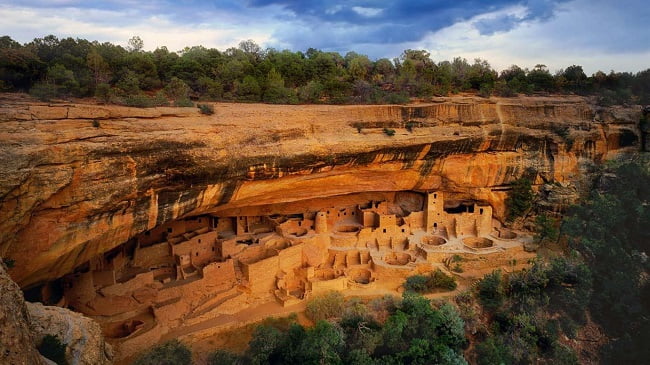
About 1200 there was another major population shift. The people began to move back into the cliff alcoves that had sheltered their ancestors long centuries before. Perhaps it was for defense; perhaps the alcoves offered better protection from the elements; perhaps there were religious or psychological reasons. Whatever the reason or combination of reasons, it gave rise to the cliff dwellers for which Mesa Verde is most famous.
Most of the cliff dwellings were built from the late 1190's to the late 1270's. They range in size from one-room houses to villages of more than 200 rooms - Cliff Palace. Architecturally, there is no standard ground plan. The builders fit their structures to the available space. Most walls were single courses of stone, perhaps because the alcove roofs limited heights and also protected them from erosion by the weather. The masonry work varied in quality; rough construction can be found alongside walls with well-shaped stones. Many rooms were plastered on the inside and decorated with painted designs.
Kiva is a Hopi word for ceremonial room. The kiva at Mesa Verde were underground chambers that may be compared to churches of later times. Based upon modern Pueblo practices, Ancestral Puebloans may have used these rooms to conduct healing rites or to pray for rain, luck in hunting, or good crops. Kivas also serve as gathering places, and sometimes as a place to weave. A roof of beams and mud covered each kiva, supported by pilasters. Access was by ladder through a hole in the center of the roof. The small hole in the floor is a sipapu, the symbolic entrance to the underworld.
The Ancestral Puebloans lived in the cliff dwellings for less than 100 years. By about 1300 Mesa Verde was deserted. There are several theories about the reason for their migration. We know that the last quarter of the century was a time of drought and crop failures, but these people had survived earlier droughts. Maybe after hundreds of years of intense use, the land and its resources - the soil, forests, and animals - were depleted. Perhaps there were social and political problems, and the people looked for new opportunities elsewhere.
When the people of Mesa Verde left, they traveled south into New Mexico and Arizona, settling among their kin already there. Whatever happened, some of today's Pueblo people, and perhaps other tribes, are descendants of the cliff dwellers of Mesa Verde.
Survey History of Mesa Verde National Park
Mesa Verde National Park was established in 1906, coeval with the Antiquities Act. The act was passed in response to a growing concern about private and commercial removal of American antiquities, particularly in the Southwest. Several years after the park was established, cataloging and preserving the wealth of resources that resided in it became an important priority and the need for survey of these resources became apparent. Before the Mesa Verde GPS Project, four extensive surveys and many smaller scale surveys had been completed.
The first large scale survey conducted at Mesa Verde National Park attempted to map Chapin Mesa, from the north escarpment to the south park boundary. Don Watson, the park archaeologist, submitted a proposal to conduct the survey in 1949, and was subsequently funded in 1951. The project was designed to "locate, list, mark and describe all archaeological sites: pithouses, pueblos, cliff dwellings, dams, canals and pictographs." These goals were met in a general way. The final survey report included sketch maps of sites, descriptions of representative artifacts and general site characteristics, but because of the limited budget and inadequate equipment, the exact location of the sites were not established. In fall of 1954 the survey concluded having recorded over 900 archaeological sites ranging from Modified Basketmaker (BM111) to Classic Pueblo (Pueblo 111) (Smith, Request for Proposal - 1984, 1490-84-03).
The survey of Wetherill Mesa, conducted by Alden Hayes, began in 1958. Wetherill Mesa was chosen because it was a smaller area, and therefore manageable, and because it was becoming famous for having the second largest cliff dwelling within the park known as, Long House. Hayes attempted to rectify some of the problems experienced by the earlier surveyors by using transmitters and receivers, which were used to triangulate from known points to archaeological sites. This proved to be an improvement, but the exact locations of the transmitters, which were moved and reestablished periodically were not recorded, hence the plotted locations are more accurate than Chapin Mesa Survey, but it is still impossible to reproduce the locational process on 1:24000 scale USGS maps. The survey was completed in the fall of 1960 and the crew had recorded 800 sites (Smith, Request for Proposal - 1984, 1490-84-03).
The University of Colorado, employing Jack Smith as the Principal Investigator, began a survey of the entire park in 1971, excluding Chapin Mesa and Wetherill Mesa. The survey used a network of reference points which were established in the field and then plotted on 1:24000 scale topographic maps. These were then used by the survey crews either for direct sight triangulation or as bases for running traverses to the sites. The reference points were set in highly visible locations such as hill tops, prominent points on ridges, or in open canyon areas, whenever possible. To increase their visibility the locations were marked with long bamboo poles with 20 cm. diameter styrofoam balls at the end. The styrofoam balls were wrapped with aluminum foil or painted a bright orange. These markers were tied to the tops of trees or other prominences directly above the reference points. Survey crews could usually take readings on two or more of these bright objects with the tripod-mounted Brunton transits. Where only one point was visible, angles and distances were read from the site to the point, and the readings were obtained by trigonometric calculation to a single azimuth and a straight line distance from the reference point to the site. These readings were then used to plot the site onto the base map (Smith,1985:90).
In 1984 the Park decided that because of the inaccurate site location information on Chapin Mesa, a resurvey would be done by P-111 Associates. The primary objective of the resurvey was to relocate all of the archaeological sites previously recorded. When the sites were located it was necessary to record the position by means of triangulation, using established points (of which there were few), or by traverses. The traverse method required connecting the site location with an established point and measuring from one to the other. The locational information was then plotted on oversized 1:24000 scale U.S.G.S. topographic maps of Mesa Verde National Park. The second goal was to record any archaeological sites which were not recorded during the original survey. When these sites were discovered, complete records were taken. When P-111 completed the survey, after 65 days of work, they had relocated 513 sites (Lucius and Schroedl,1986:7).
Each of the surveys mentioned above used reinforcement rods (stakes) with numbers stamped on the side to mark the sites. It is unclear as to which survey group put down which stake, other than assuming that each group that worked in a certain area was responsible for the stakes laid in this area. Originally there were 1583 stakes laid in the park, the number of surviving stakes is unknown at this time. The GPS survey team only collected information on sites that had stakes.
The Cultural Sites Inventory (CSI) has two components: archaeology and ethnography. The archaeological component of the CSI is a management registry of all of the known historic and prehistoric sites in a park and contains the baseline data required by the Secretary of the Interior's "Standards for Archaeological Documentation". It does this through documentation of the location, description, significance, condition, threats and management requirements of these sites; and summarizes the extent of archaeological identification, evaluation, and data collection activities in a park (Cultural Resource Management NPS-28). The majority of this work has been conducted by personnel at Midwest Archaeological Center (MWAC) with the exception of a few parks, such as Mesa Verde National Park. For Mesa Verde National Park, MWAC compiled a mylar base map of sites recorded from 1971 to 1977 by the University of Colorado for the park. MWAC also provided a blank copy of the CSI database structure and data definitions to the park in the late 1980's, however, no site specific data files have been provided to the park by MWAC. All data entry in that database has been completed by park personal.
Time Line
1765: Don Juan Maria de Rivera, under orders from Tomas Velez Cachupin, then governor of New Mexico, led what was possibly the first expedition of white men northwest from New Mexico. Rivera set out from Santa Fe to the San Juan River, crossed the southern spur of the La Plata Mountains, then traveled down the Dolores River, crossed eastward over the Uncompahgre Plateau and then down the Uncompahgre River to the Gunnison River.
1859: Professor J. S. Newberry, in his geological report of an expedition under the leadership of Captain J. N. Macomb to explore certain territory in what is now the State of Utah, makes the first known mention of Mesa Verde. It seems quite evident from his description that Newberry must have climbed to one of the highest points of Mesa Verde, possibly Park Point, and the manner in which he uses the name Mesa Verde suggests that the name was in common usage. Newberry must not have explored much of Mesa Verde because he makes no mention of cliff dwellings.
1874: The first cliff dwelling in the Mesa Verde area known to have been entered by white men, was Two-Story Cliff House in Ute Mountain Tribal Park, discovered by W. H. Jackson in September. Jackson was a photographer for the U. S. Geological and Geographical Survey. He had heard of ruins in Mesa Verde from miners and prospectors. One of these prospectors, John Moss, led Jackson into Mancos Canyon where the cliff dwelling was discovered. Jackson found other small cliff dwellings in the canyon, but Two-Story Cliff House was the only one he named.
1875: The second cliff dwelling in Mesa Verde area to be named was Sixteen Window House. It was discovered by W. H. Holmes, leader of another government survey party that passed through Mancos Canyon.
1884: Balcony House was entered by a prospector, S. E. Osborn. His name and the date March 20, 1884, were found in a dwelling in lower Soda Canyon.
1886: The first known suggestion that the area be set aside as a National Park appeared in an editorial in the Denver Tribune Republican, December 12, 1886.
1888: On December 18, Richard Wetherill and his brother-in-law, Charles Mason, rode out on what is now Sun Point in search of lost cattle and first saw Cliff Palace. That afternoon, Richard found Spruce Tree House, and the next day, the two men discovered Square Tower House. Al Wetherill, Richard's brother, saw Cliff Palace sometime the year before, but he did not enter the dwelling, so the credit for "discovering" the dwelling has been given to Richard Wetherill and Charles Mason.
1889: Four of the Wetherill brothers returned to Mesa Verde to explore and dig in the ruins. In a 15 month period, they claimed to have entered 182 cliff dwellings, 106 in Navajo Canyon alone.
1890: In the January 1, 1890 issue of the Durango Herald, there is an article on Montezuma County, expressing the idea of setting aside the Mancos Canyon cliff dwellings as a National Park.
Between 1887 and 1892 the Wetherills made several trips into Mesa Verde primarily for collecting archeological material. There were at least eight individual collections assembled by the Wetherills during this period, several of which were later combined and sold as four collections.
1891: Baron Gustaf E. A. Nordenskiold, of the Academy of Sciences, Sweden, visited Mesa Verde in 1891. He is credited as being the first scientist to visit the cliff dwellings. He made a collection of about 600 items which were sent to Sweden and are now in the National Museum in Helsinki, Finland.
1901: The first bill introduced before Congress to create a National Park in the Mesa Verde was introduced February 22. The bill provided for the creation of the "Colorado Cliff Dwellings National Park". It never returned from the Public Lands Committee.
1901 to 1903: Two bills were introduced during the 57th Congress in the House of Representatives for the creation of the park. Both bills died in committee. Congressional authority was secured, however, authorizing the Secretary of the Interior to negotiate for the relinquishment of the Mesa Verde tract from the Utes and an appropriation for the survey of the area.
1903 to 1905: Two more bills were introduced in the 58th Congress for the creation of the "Colorado Cliff Dwellings National Park". One of the bills (the Hogg bill) was reported back from committee with several amendments but did not receive any further action.
1906: The first bill for the creation of "Mesa Verde National Park" was introduced in the 59th Congress in 1905. This bill was subsequently passed on and Mesa Verde National Park was created June 29, 1906. It was signed by President Theodore Roosevelt.
Another bill passed by the 59th Congress was an "Act for the Preservation of American Antiquities", commonly referred to as the Antiquities Act of June 8, 1906. This Act made it a Federal crime to collect or destroy any historic or prehistoric object or building on federally owned land.
1908: Two years after the establishment of the park, excavation and repair of the major sites was begun so that visitors could see and enjoy the park. Most of the early work was done by Jesse Walter Fewkes, archeologist, Smithsonian Institution.
1959 to 1972: The Wetherill Mesa Archeological Project is underway. Excavation of three cliff dwellings (Long House, Mug House, and Step House), a survey of Wetherill Mesa, and excavation of selected mesa-top sites are completed.
Geology
(The following information is taken from a book by Mary O. Griffitts entitled Guide to the Geology of Mesa Verde National Park. This book is availabe for sale from the Mesa Verde Museum Association for $5.95)
The sequence of rocks exposed on the mesas originated in a great inland sea that began to cover this area about 100 million years ago. As the water encroached over a low, relatively flat erosion surface, streams from the west brought sands and muds into the shallow water. These shoreline deposits consisted of beach sands, shallow water cross-bedded shore sands, lagoonal and swamp muds, and deltaic sands at the mouths of inflowing streams. These deposits are now the brown Dakota Sandstone seen in the Cortez Valley below the Mesa Verde. This particular layer is not exposed within the boundaries of Mesa Verde National Park.
The sea continued to advance until the Mesa Verde region was far out from the shoreline that was probably close to what is now the western edge of Utah, some 200 miles away. The sediments deposited change from the coarser, near shore, sandy deposits to fine, evenly bedded shales. In all, about 2,000 feet of Mancos Formations were deposited in quiet offshore conditions, and is now exposed in the steep, dark gray shale slopes of the north escarpment. Although the Mancos Shale appears to be a great shale mass, it is not one homogeneous unit. The sediments were deposited over a ten million year period and consist primarily of shales with some limestones. It took over 10 million years to deposit the 2,000 feet that make up the Mancos Formation. Variations in environments throughout time are well documented in rock types and in an abundant and varied fossil record. The sea reached its greatest extent during the deposition of the Mancos Shale, and then began a slow withdrawal. The Mancos Shale is visible as visitors drive into the park from the entrance station to approximately Mile Post 4 near the Morefield Campground.
Overlying the thick Mancos Formation is the Mesa Verde Group of formations. This group is subdivided into three formations; from the oldest, the Point Lookout Sandstone, to the Menefee Formation, to the Cliff House Sandstone, which is the youngest. The Point Lookout Sandstone is seen as visitors travel from Morefield Campground through the tunnel on the main road and then through Prater Canyon. As one travels through the switchbacks past the Montezuma Valley Overlook, exposures of the Menefee Formation become evident. Finally, upon reaching the Far View Visitor Center, the Cliff House Sandstone is the predominant formation visible.
Sand was brought into the sea, the water became shallower, and the shales became progressively sandier. The massive shallow water Point Lookout Sandstone overlying and grading into the Mancos Formation was named for the prominent Point Lookout overlooking the flat plain. Few fossils remain in this formation because sediments were deposited in a zone of vigorous wave and current action.
The sea continued to withdraw to the northeast, and a broad, low coastal plain emerged. Woody shales, coals, and coarse irregular sands were deposited in broad, shallow swamps and along stream and interstream areas and became the sediments of the Menefee Formation. Many plant fossils are evidence of lush vegetation and show that the climate was wet and warm during this period when the land was only slightly above the sea.
The sea again lapped farther south. Beach sands and shallow water sands were then deposited, forming the Cliff House Formation which now caps the mesa. This formation takes its name from the presence of the famous cliff dwelings in the alcoves and niches weathered in these sandstones. The alcoves are formed by the action of the ground water percolating through the porous sandstones until it reaches an impervious layer and then moves along this water barrier to the canyon edge. Freezing, thawing, chemical, mechanical, and wind eriosion all continue to enlarge the niches along the canyon walls. The Cliff House Formation contains many invertebrate and vertebrate fossils. Most of the vertebrate remains were broken due to wave action at the time of deposition. The fossils near the top of the formation have been dated at approximately 87.5 million years old.
Uplift of the area at the end of the Cretaceous Period drained the sea and initiated a long period of erosion which gave rise to the present topography. Laccolithic igneous intrusions gave rise to the La Plata Mountains to the north and Ute Mountain to the west. Much of the flat mesa surface of the Mesa Verde and the Cortez Valley are covered with varying depths of red wind blown soil (loess) which has been accumulating for one million years.
Copyright © 1995 - 2007 Hillclimb Media
This site is in no way associated with the United States Government, the Department of the Interior or the National Park Service