|
|
|
|
|
|
General Information
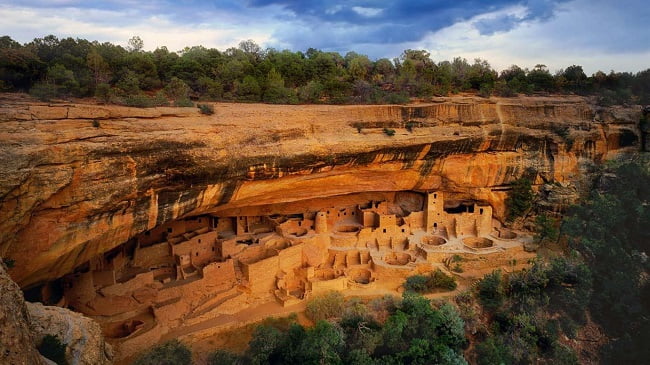
Mesa Verde, Spanish for "green table", offers an unparalleled opportunity to see and experience a unique cultural and physical landscape. The culture represented at Mesa Verde reflects more than 700 years of history. From approximately A.D. 600 through A.D. 1300 people lived and flourished in communities throughout the area, eventually building elaborate stone villages in the sheltered alcoves of the canyon walls.
Today most people call these sheltered villages "cliff dwellings". The cliff dwellings represent the last 75 to 100 years of occupation at Mesa Verde. In the late 1200s within the span of one or two generations, they left their homes and moved away.
The archeological sites found in Mesa Verde are some of the most notable and best preserved in the United States. Mesa Verde National Park offers visitors a spectacular look into the lives of the Ancestral Pueblo people. Scientists study the ancient dwellings of Mesa Verde, in part, by making comparisons between the Ancestral Pueblo people and their contemporary indigenous descendants who still live in the Southwest today. Twenty-four Native American tribes in the southwest have an ancestral affiliation with the sites at Mesa Verde.
To fully enjoy Mesa Verde National Park, plan to spend a day or two exploring its world-class archeological sites as well as its beautiful landscape. The entrance to the park is 9 miles east of Cortez and 35 miles west of Durango in Southwestern Colorado on US Highway 160.
Mesa Verde National Park preserves a spectacular reminder of the 1,000 year culture of the Ancestral Puebloans. Archeologists have called this people Anasazi, from the Navaho word that means "ancient". They are now called Ancestral Puebloans, reflecting their modern descendants
The sites found at Far View are a series of surface structures that date to different time periods. Located close to each other and linked by a trail system are several excavated and stabilized sites that include Far View House, Pipe Shrine House, Coyote Village, Far View Resevior, Megalithic House, and Far View Tower. Most of the sites found at Far View were probably built prior to the construction of Cliff Palace and other cliff dwellings.
The Badger House Community
The Badger House Community consists of several stops that can be made while walking a level pleasant trail through the woods.
Allow approximately one hour to take in the information and the views. After completing the walk visitors pick up the tram on the other end of the trail. The tram then takes visitors to overlooks of Kodak House and Long House and then back to the main parking area.
Balcony House Ruins
Balcony House ruins has ranger-led tours late May through late Oct. Visitors must obtain a ticket for the tours at the Far West View Visitor Center the day of their visit. There are no advanced reservations. This tour requires climbing a 30 foot ladder and crawling through a tunnel. The site is closed during the winter.
The Balcony House tour begins from the benches under the shade ramada at the Balcony House parking lot.
A Balcony House tour is quite an adventure. A visit to Balcony House will challenge your fear of heights and small places. For those willing to go on an adventure it is fun and exciting. The Balcony House tour requires people to descend a 100 foot long staircase into the canyon to get below the dwelling. To tour Balcony House, visitors must climb a 32 foot tall ladder, crawl through a 12 foot long tunnel, and then climb an additional 60 feet on ladders and stone steps. The Balcony House tour is one of the most challenging in the park.
The tour of Balcony House is considered strenuous due to the elevation and physical exertion required to visit the dwelling. The tour is not recommended for anyone with heart or respiratory problems. All of the cliff dwellings are located at approximately 7,000 feet elevation and involve moderately strenuous physical activity.
To see Balcony House from a distance use the Soda Canyon Overlook which is located at the end of a 3/4 mile trail. The parking for the overlook trail is just beyond the Balcony House parking area.
Balcony House was entered by a prospector, S. E. Osborn, some time during the spring of 1884. His name and the date March 20, 1884, have been found in a dwelling in lower Soda Canyon. In a newspaper article published late in 1886, Osborn describes some of the sites he visited in the Mesa Verde in 1883- 1884. The description of one of these is so much like Balcony House there is very little doubt that he did enter it.
Balcony House was prepared for people to enter it in 1910 by Jesse Nusbaum. Nusbaum was not only an accomplished archeologist, he was also one of the first Superintendents of Mesa Verde National Park.
Cedar Tree Tower
Cedar Tree Tower is one of several tower sites that have been discovered on the mesa tops. Towers were primarily built during the Classic period (A.D. 1100 to 1300) at Mesa Verde and are usually associated with a kiva. The purpose of a tower-kiva complex is not known. Some speculation is that towers had a ceremonial purpose based on their close association with kivas. Other people have proposed that the mesa top towers were part of a communication system.
Adjacent to the Cedar Tree Tower area is the trailhead for the Farming Terrace Trail. This 1/2 mile loop trail provides an opportunity for a leisurely hike through the pinyon juniper forest. Along the trail there is a good example of an Ancestral Puebloan farming terrace.
Terracing was a common farming strategy used by the people of Mesa Verde. Today we wonder what prompted the people of this region to create farm plots in the natural drainages. Was it to take advantage of water run-off from the mesa tops after a rain storm? Or was it to trap rich top soil before it could be completely washed away? Rich top soil would have been washed down into the canyon bottoms if farming terraces and check dams hadn't otherwise trapped the moist rich soil. They took advantage of the natural landscape.
Take this walk and learn more about how farming was accomplished 800 years ago.
Chapin Mesa Museum
Hours:
8:00 am to 6:30 pm - Daily - Summer
8:00 am to 5:00 pm - Daily - Rest of Year
The museum is located on Chapin Mesa, 20 miles from the park entrance. Self-guided trail of Spruce Tree House in spring, summer, and fall. Free ranger-guided tour of Spruce Tree House in winter, 3 times daily. Park video plays in auditorium every half-hour. Museum shows the chronology of the Ancestral Puebloan culture. Water and restrooms are located near the museum. A snack bar, gift shop, and bookstore are located near the museum.
Cliff Palace Tour
The Cliff Palace has ranger-led tours from mid Apr to mid Nov. Visitors must obtain a ticket for the tours at the Far West View Visitor Center the day of their visit. There are no advanced reservations. The site is closed during the winter. There is an excellent view from observation platform. Good views within the site and from Sun Temple area.
Far View Visitor Center
Hours:
8:00 am to Sunset - Daily - mid Apr - mid Nov (weather permitting)
There is a self-guided tour of mesa top pueblos.
The sites found at Far View are a series of surface structures that date to different time periods. Located close to each other and linked by a trail system are several excavated and stabilized sites that include Far View House, Pipe Shrine House, Coyote Village, Far View Resevior, Megalithic House, and Far View Tower. Most of the sites found at Far View were probably built prior to the construction of Cliff Palace and other cliff dwellings.
Periodic weekend cultural demonstrations are held in the Summer on balcony of Visitor Center. Historic Native American jewelry, pottery, and basket displays and the Nordenskiold exhibit are housed here. Tickets for cliff dwelling tours can be purchased here. Restrooms located at Visitor Center. The lodge, restaurant, cafeteria, and gift shop are located near the Visitor Center.
Spruce Tree House Cliff Dwelling
The Spruce Tree House cliff dwelling are open all year. There are self-guided tours in the summer and ranger lead tours in the winter (weather and trail conditions permitting). This is the only tour available during the winter.
Sun Temple
According to modern Pueblo Indians, Sun Temple's features classify it as a ceremonial structure. The symmetrically planned "D" shaped building was never completed, yet its size alone points to the amount of labor that went into its construction. Based upon the amount of fallen stone removed during excavation, the walls probably were between 11 and 14 feet high. Notice the excellent masonry. The stones were shaped and given a "dimpled" flat surface by the builders of the structure.
Work on the structure apparently stopped when the Ancestral Puebloan people began moving out of Mesa Verde around A.D. 1276. The purpose of the modern concrete on top of the walls is to prevent moisture from going into the rubble that has been placed between the walls.
At the southwest corner of Sun Temple there is an eroded stone next to the wall with three small indentations that may have served as a sun dial to mark the change of seasons. Although never completed Sun Temple reflects a great construction effort by the people who once lived at Mesa Verde.
Wetherill Mesa Ruins
The Wetherill Mesa ruins are open from Memorial Day through Labor Day only. Private vehicles are allowed on the twelve mile stretch from Far View Visitor Center to the parking area on Wetherill Mesa. From there take the tram for a ranger led tour of Long House and the self guided tour of the Badger House Community of mesa-top villages. Visitors must obtain a ticket for the Long House tour at the Far View Visitor Center. There are no advanced ticket reservations.
Sharp curves and steep grades limit types of vehicles allowed on the road. The length limit is 25 feet, gross weight limit is 8,000 pounds. Bicycles are not allowed on this road due to safety.
Geology Stops
Listed below are the best locations to view and understand Mesa Verde National Park geologic features. Wayside exhibits and trail guides will assist you in interpreting the park geology.
Geologic Overlook is a stop along the main park road. A short walk on the trail from the parking area will lead you to the overlook and soon to be installed wayside exhibits that discuss the area geology as well as other park topics.
Knife Edge Trail (1.5 miles) is accessed in Morefield Campground. Take along the trail guide to learn about area geology as well as other park topics. Because of safety concerns due to this trail being burned over in the Bircher Fire in the summer of 2000, Knife Edge Trail is closed until further notice.
Montezuma Overlook is a stop along the main park road. The overlook has soon-to-be-updated exhibits that discuss area geology as well as other park topics.
Park Point is the highest point on the main park road. A short walk on the trail from the parking lot will lead you to the overlook and wayside exhibits that discuss area geology as well as other park topics.
Petroglyph Point Trail (2.8 miles) is accessed near the museum and Spruce Tree House. Take along the trail guide to learn about area geology as well as other park topics.
Spruce Tree House Trail (0.5 miles) is accessed near the museum. Take along the trail guide to learn about area geology as well as other park topics.
Picture Taking Tips
You can take good pictures home of your Mesa Verde visit if the following suggestions are noted.
Some cliff dwellings are open only from late spring through early fall. During the off-season, photos may be taken from the overlooks above the cliff dwellings, weather permitting.
| June to September | 3:45 p.m. to 6:00 p.m. |
| October and November | 2:30 p.m. to 5:30 p.m. |
| December to March | 2:00 p.m. to 5:00 p.m. |
| April and May | 2:30 p.m. to 5:30 p.m. |
During mid and late fall and early and mid spring the sun is lower in the southern sky and more light strikes the cliff dwellings. Winter light is generally less bright. On overcast days the soft light allows for photos to be taken that will show good details and subtle colors. During the winter months there is less vegetation obstructing views from the overlooks after the scrub oak has lost its leaves for the season.
Balcony House faces east. Best with a telephoto lens. The site is in full sun throughout the morning. Balcony House is fully shaded during the afternoons. Close up shots can be taken on tour.
Cliff Palace faces west and is best photographed in the late afternoon. Cameras should have shoulder strap as you must climb four different ladders in the site and will need both hands free.
Far View sites have direct sunlight all day. A wide angle lens is helpful here and at nearby Mummy Lake.
Sun Temple is a hard site to photograph. Wide angle lens is helpful. Direct light all day. There is also a good view of Cliff Palace from the Sun Temple parking area.
Spruce Tree House cliff dwellings has a panoramic view from the trail to the site. The site faces west and is best photographed in the afternoon.
Square Tower House Overlook is located on the west loop of the Mesa Top Road. In sunlight all afternoon though most graphic about 5:30 p.m. It is a good vantage point. The road is open from 8:00 a.m. until sunset.
Fewkes Canyon Overlooks is located on the west loop of the Mesa Top Loop Road. A number of different cliff dwellings can be photographed all afternoon from these overlooks. The road is open from 8:00 a.m. until sunset.
The sites on Wetherill Mesa are accessible only during the summer months, from Memorial Day through Labor Day.
Copyright © 1995 - 2007 Hillclimb Media
This site is in no way associated with the United States Government, the Department of the Interior or the National Park Service